Skip to content

Ford Pro

Notification Framework

Creating one notification system across a fragmented enterprise ecosystem.

Ford Pro had notifications being created across multiple products, platforms, and teams without a shared framework. I led the experience strategy and research that helped reframe the problem from individual messages to a scalable enterprise system built around events, roles, priorities, preferences, and governance.

Hand holding a phone showing the Ford Pro app vehicle status screen beside an electric Ford Transit van
Client
Ford Pro
Timeframe
2023–2024
Role
UX Director & Researcher
Team
GCD Experience Design · Sr. UX Designer · Researcher
Platform
Enterprise ecosystem · Web · Mobile

01

The Challenge

The notification problem was not simply inconsistent messaging. It was a fragmented system with duplicated effort, unclear ownership, and different rules across teams and platforms.

Customer

Users experienced inconsistent, repetitive, or poorly prioritized notifications across Ford Pro services.

Business

Fragmented notification logic created inefficiency, reduced relevance, and weakened trust in the broader experience.

Organization

Multiple teams, platforms, and products were solving notification problems independently with no shared governance model.

02

My Role

I led the strategic framing of the problem, directed research, and helped multiple teams align around a shared enterprise model.

I led

  • Experience strategy
  • Research direction
  • Framework definition
  • Stakeholder alignment
  • Prioritization across teams

I facilitated

  • Stakeholder interviews
  • Cross-functional working sessions
  • Scenario discussions
  • Alignment around shared principles
  • Design and strategy critiques

I did

  • Research synthesis
  • Ecosystem mapping
  • Scenario modeling
  • Framework definition
  • Recommendations
  • Validation planning

My role was not limited to directing the work. I also worked directly in the research synthesis, framework development, and scenario modeling where hands-on contribution helped the team move faster and create clarity.

03

The Shift

  1. Step 1: We started with

    Individual teams trying to improve notification experiences within their own products.

  2. Step 2: We realized

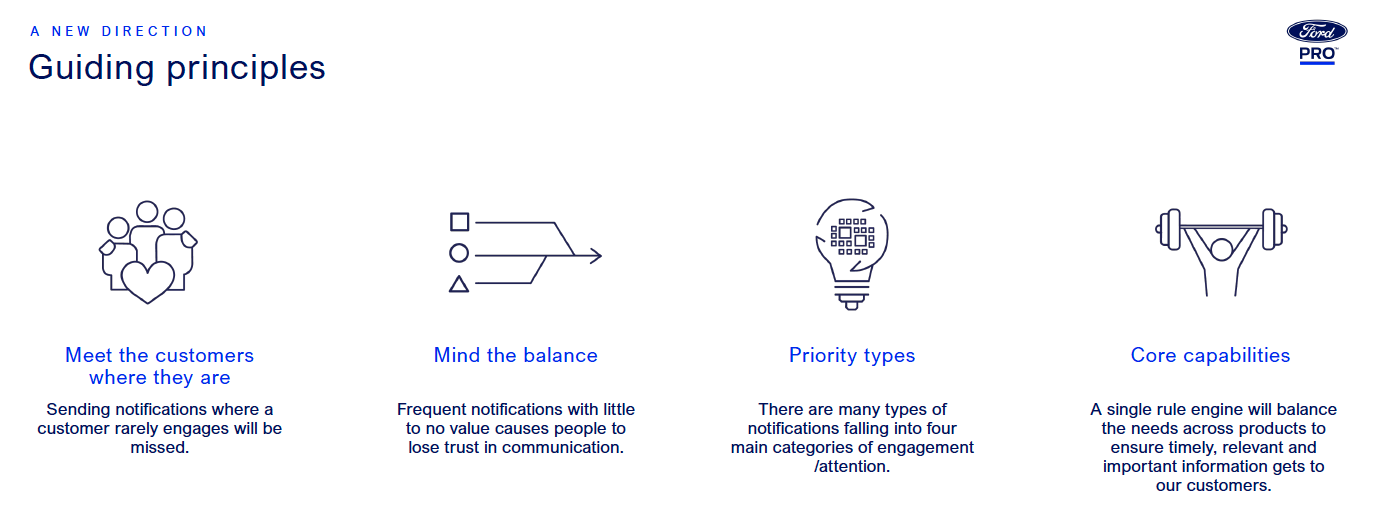
    The larger problem was fragmentation — different systems, priorities, roles, and rules were creating inconsistent customer experiences.

  3. Step 3: We shifted toward

    A shared enterprise notification framework that could scale across products, roles, platforms, and future experiences.

Ford Pro slide titled "Guiding principles" under the label "A new direction", listing four principles: meet the customers where they are, mind the balance, priority types, and core capabilities.

04

What I Changed

The strategy came to life through three key moves.

01

Created a shared view of the ecosystem

We first needed to understand how notifications were being created, delivered, and experienced across Ford Pro.

  • Mapped fragmented systems and delivery patterns
  • Identified duplication and inconsistency
  • Surfaced gaps in ownership and governance
  • Compared notification behavior across platforms

My role

Directed the discovery effort, synthesized the findings, and helped frame the problem at the enterprise level.
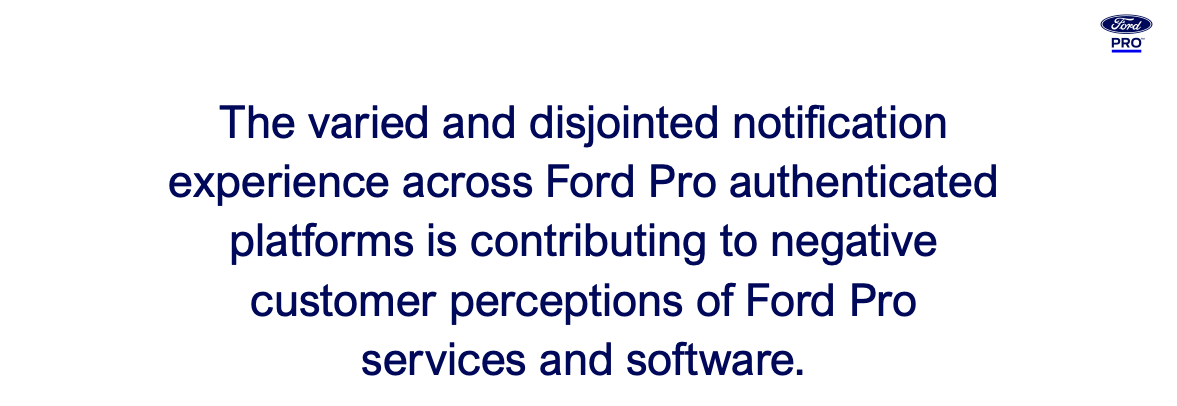
Ford Pro slide stating: "The varied and disjointed notification experience across Ford Pro authenticated platforms is contributing to negative customer perceptions of Ford Pro services and software."

02

Defined the framework

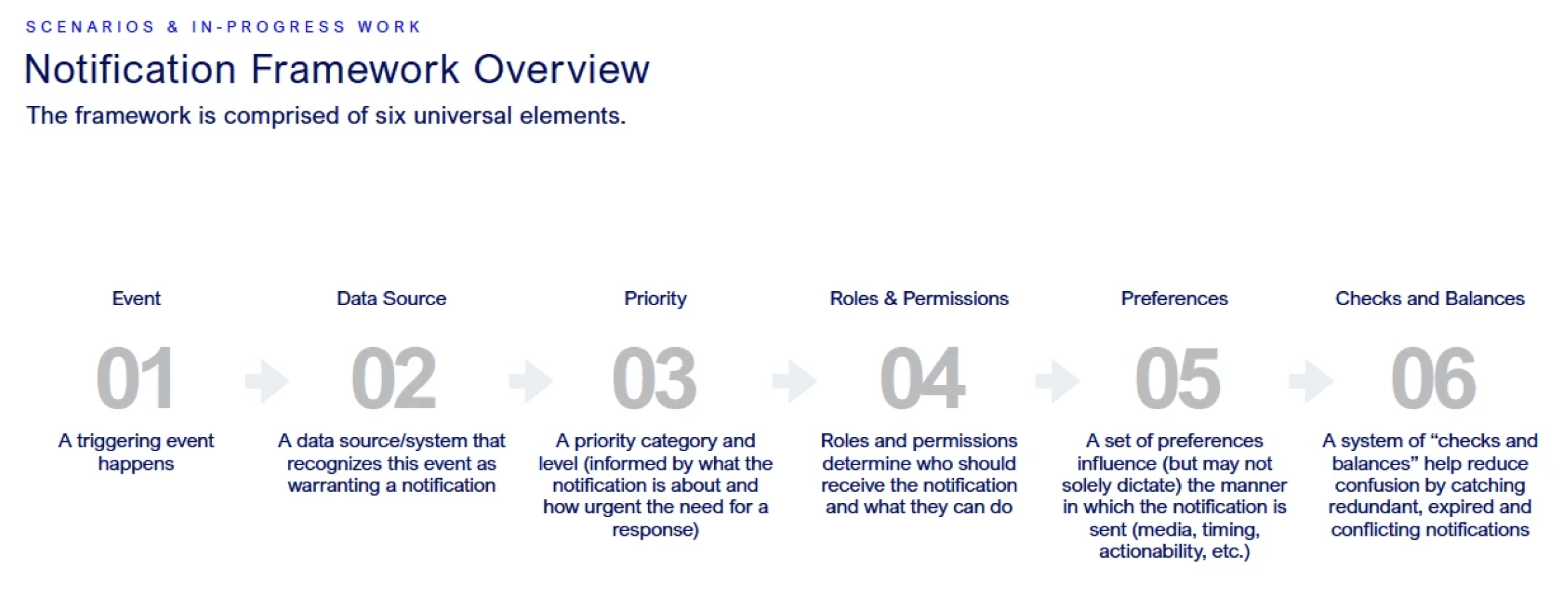
Rather than designing individual notifications, we created a framework that defined the universal elements every notification needed to consider.

  1. 01Event

    A triggering event happens.

  2. 02Data Source

    A system validates or recognizes the event.

  3. 03Priority

    The notification is prioritized based on urgency and relevance.

  4. 04Roles & Permissions

    Who should receive it, based on role and access.

  5. 05Preferences

    How and where the user wants to receive communication.

  6. 06Checks & Balances

    Rules that prevent duplication, overload, or conflicting messages.

My role

Led the framework definition and translated research findings into a scalable system model.

Notification framework overview diagram showing six steps: event, data source, priority, roles and permissions, preferences, and checks and balances

03

Designed for governance, not just delivery

The framework was built to create consistency across teams, not just improve individual messages.

  • Shared notification principles
  • Clear prioritization logic
  • Role-based communication
  • Preferences and control
  • Governance across products
  • Better onboarding and education

My role

Facilitated alignment across teams and helped establish a model that could support adoption beyond a single product.

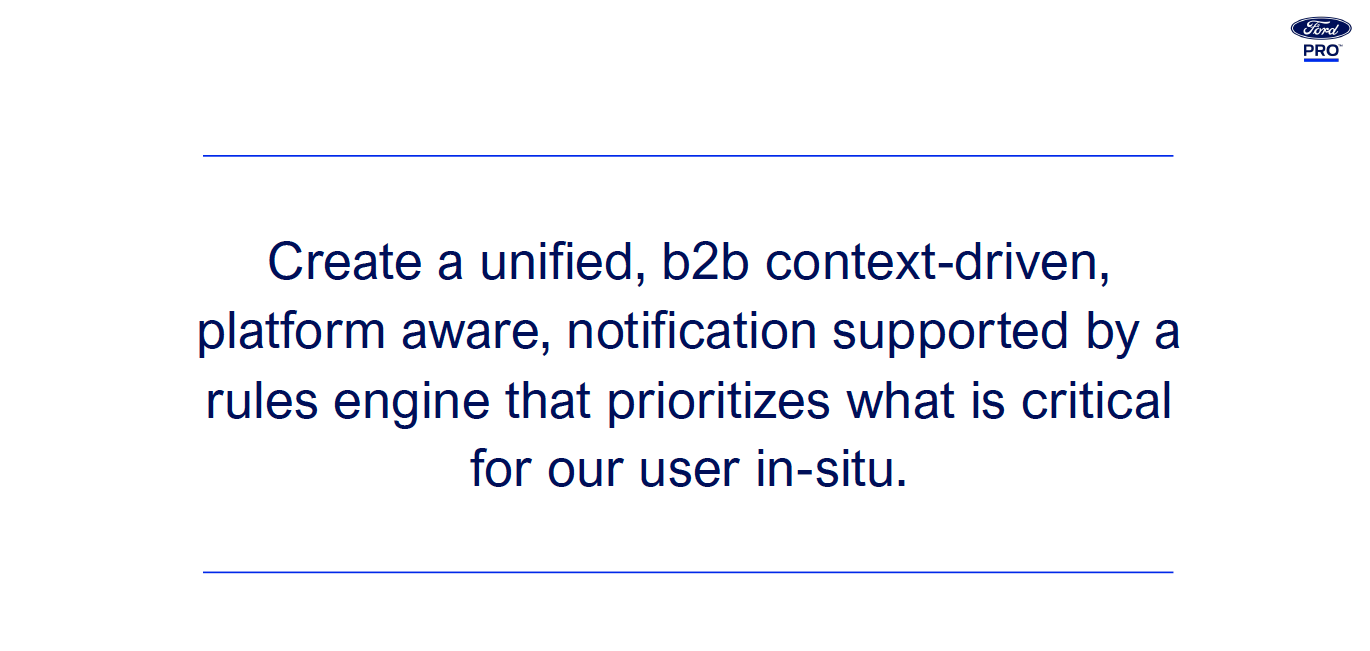
Ford Pro slide stating: "Create a unified, b2b context-driven, platform aware, notification supported by a rules engine that prioritizes what is critical for our user in-situ."

05

How Research Shaped the Framework

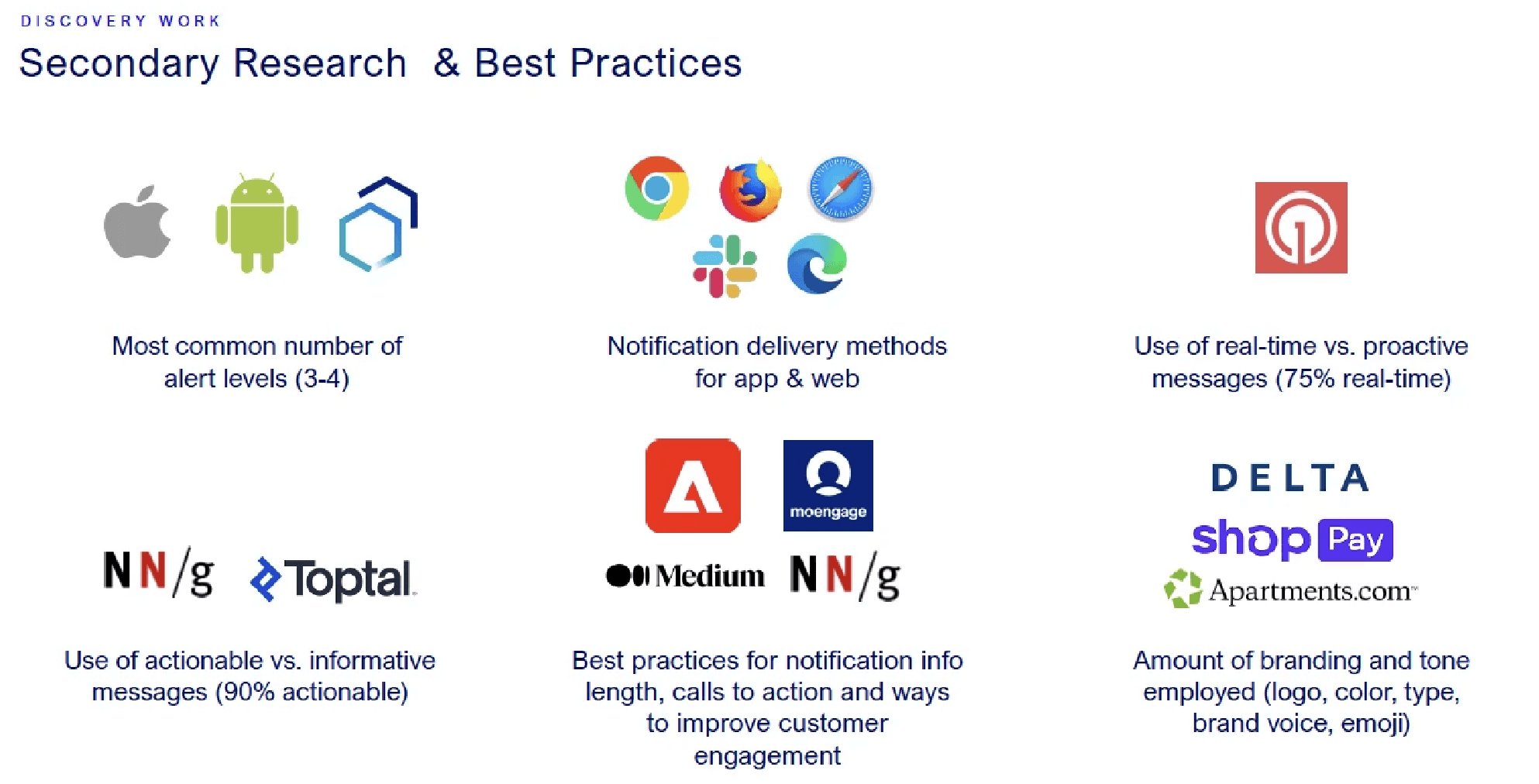
The framework was grounded in a large-scale research effort focused on both customer behavior and organizational complexity.

  • 20+ stakeholder interviews
  • 30+ secondary research insights
  • Competitive analysis across enterprise and consumer notification systems
  • Affinity mapping to identify key themes, gaps, and opportunity areas
  • Scenario-based testing to validate real-world fleet-management workflows

What we learned

  • Notification governance needed to be unified
  • Prioritization and escalation rules needed to be explicit
  • Role-based communication mattered
  • Preferences needed to give users more control
  • Systems had to support consistency without becoming rigid

My role

Directed the research approach, participated in synthesis, and translated the findings into the framework and recommendations.

Secondary research and best practices summary comparing notification alert levels, delivery methods, real-time versus proactive messages, actionable messages, and branding across consumer and enterprise products

06

What Changed

Customer impact

A more consistent, relevant, and predictable notification experience across Ford Pro products.

Business impact

Reduced fragmentation and created a stronger foundation for scalable enterprise communication.

Organizational impact

Aligned multiple teams around a shared notification model, vocabulary, and decision framework.

07

What Stayed With Me

The hardest part of enterprise UX is often not designing the interface. It is creating a shared model that multiple teams can trust and use.

This project reinforced the value of systems thinking — especially when fragmented experiences are symptoms of deeper organizational and governance issues.

The strongest progress came when stakeholders stopped reviewing individual notification examples and started making decisions together about the system behind them.